Dependencies are part of the application

Look beyond
your own code.

Understand the dependency and artifact risks around your application. Bring inventory, available scanner evidence and release decisions into a reviewable view.

Follow the artifact

An inventory lists it.
A scan evaluates it.

Illustrative artifact passport
Application artifactcatalog-service
Review recordSource / image / report
01 / Contents

Presence is not an assessment.

Dependency inventory CycloneDX
@example/clientDirect dependency
1.4.0
@example/parserTransitive dependency
2.1.0
What evaluated
these components?

A package list needs separate scanner evidence and a defined vulnerability scope.

Inventory ≠ evaluated. Unsupported or unevaluated scope remains visible; it cannot stand in for a clean result.

02 / Correspondence

The right report.
For this exact artifact.

Expected target
Checkout revision
8f42c7a…
Image digest
sha256:42f1…9a20
Scanner evidence
Reported revision
Compare with checkout
Reported digest
Compare with image

Check report integrity, origin and coverage against the intended project. A declared identifier alone does not establish binding. Identifiers shown here are abbreviated.

03 / Decision basis

Make the policy
show its working.

Establish coverage

Supported, current scanner evidence for the intended scope.

Verify identity

The relevant revision and image digest must be bound to the evidence.

Apply the configured policy

Evaluate the actual blockers. Binding alone does not make a release pass.

Missing, unsupported, stale or unbound?
Do not infer a passing scan.

Inventory, scanner evidence and release policy retain their own meaning.

Not a production verdict
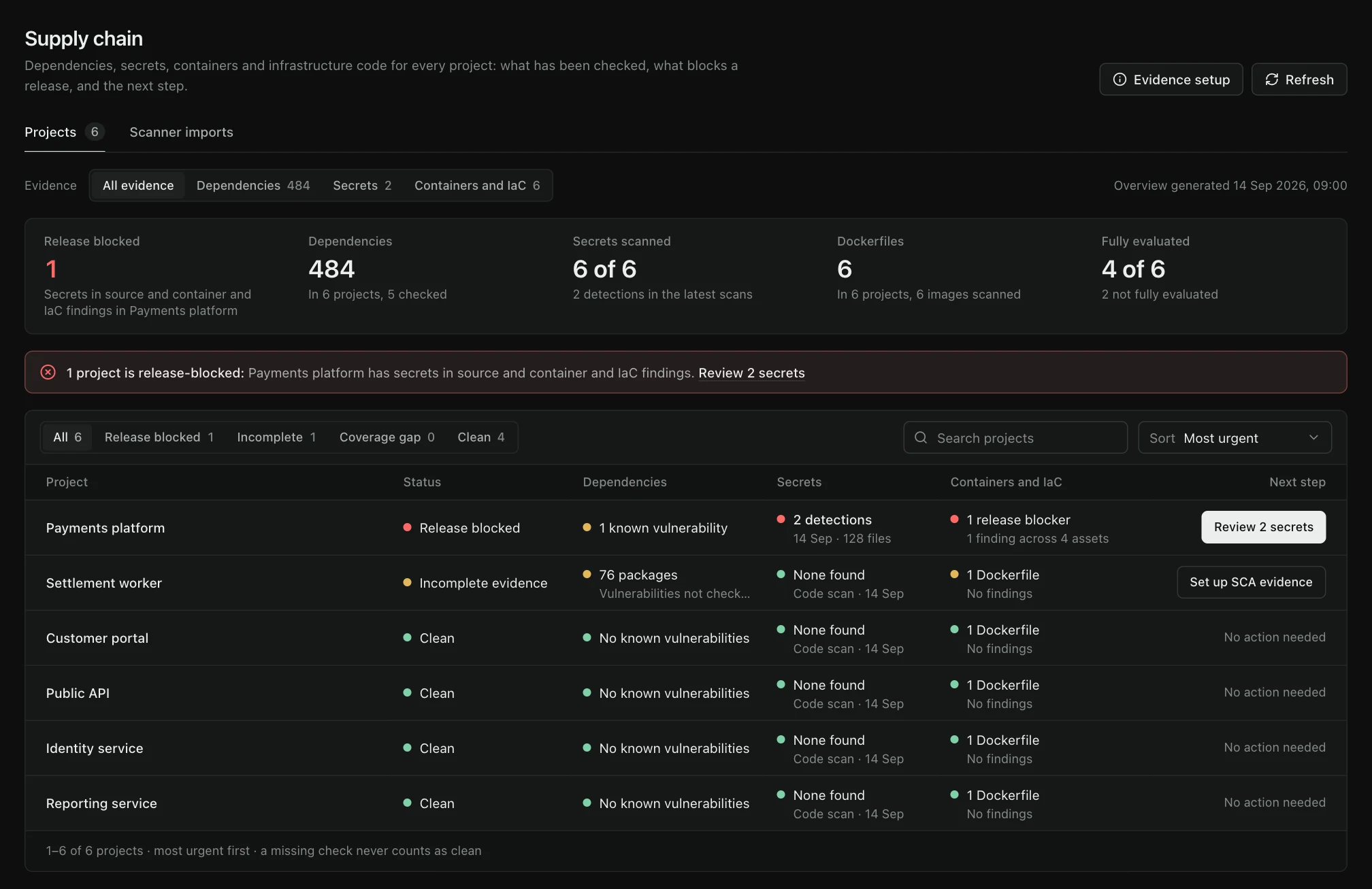
TraceMint Supply Chain Security workspace with illustrative project data.
TraceMint interfaceIllustrative demo dataView full size — opens image in a new tab↗
How it fits your workflow

Inventory. Evidence.
A release decision.

01 / Supply Chain Security

Understand the inventory

Review the supported dependency and artifact information available for the project.

02 / Supply Chain Security

Check the evidence

Inspect the scanner inputs, evaluated scope and relevant revision or digest when available.

03 / Supply Chain Security

Review the release decision

Read the applied policy and blockers. Keep missing or unbound evidence distinct from a passing result.

Evaluation brief / Supply chain

Separate the inventory.
Bind the decision.

A package list, a scanner report and a release decision answer different questions. Evaluate how TraceMint preserves those boundaries and connects them to the right source revision or artifact.

Inventory / 01

What components were identified?

Generate and review the dependency inventory for the supported project inputs, including the manifest coverage and omissions behind it.

Portable record
CycloneDX 1.5 dependency inventory
Review together
Manifests, resolved packages and coverage notes
Do not conflate
Inventory presence and vulnerability evaluation
Decision boundary

An SBOM or package inventory is not evidence that every dependency was evaluated for vulnerabilities.

Acceptance check

Test the package managers and repository layout used by your delivery pipeline, including unsupported or partially parsed manifests.

Scanner evidence / 02

Which report can support this project?

Supported Trivy, Grype and npm audit artifacts retain their own import and coverage semantics. The report must be usable for the project it is attached to.

Accepted evidence
Supported Trivy, Grype or npm audit artifacts
Identity
Project plus relevant source revision or image digest
Failure state
Missing, unusable or unsupported remains visible
Decision boundary

Uploading a report is not the same as configuring a live scanner connector or proving full upstream-tool compatibility.

Acceptance check

Bring a genuine artifact from each scanner and edition you expect to use, rather than relying on a catalogue name.

Binding / 03

Does the evidence describe the thing being released?

Source evidence needs the relevant revision; container evidence needs the exact digest. A familiar tag or nearby checkout is not an equivalent identity.

Source identity
Repository revision where available
Artifact identity
Immutable image digest and platform context
Mismatch
Unbound evidence cannot earn a passing decision
Decision boundary

A customer-supplied archive or manifest declaration is not automatically a verified Git checkout or deployment attestation.

Acceptance check

Exercise both a matching revision/digest and a deliberately mismatched artifact in the evaluation.

Release policy / 04

Why did the release pass, block or remain unevaluated?

The decision should name the applied policy, evaluated blockers and missing dimensions rather than reduce every state to red or green.

Inputs
Bound inventory and available scanner evidence
Outcome
Policy result with blocker context
Delivery use
Configured CI or GitOps decision workflow
Decision boundary

Policy export is not installation in a cluster, continuous reconciliation or a separate runtime-protection product.

Acceptance check

Define one allowed release, one blocker and one incomplete-evidence case before connecting the decision to delivery.

Bring to the evaluation
  • Representative manifests and lockfiles
  • Real scanner artifacts
  • A revision and image-digest policy
Inspect a recorded configuration check
Supply Chain Security / Capabilities

Know what was scanned.
And what was not.

In focus

More than a package list

An inventory alone does not prove dependencies were evaluated for vulnerabilities. The distinction is part of the review.

Evidence has an identity

Understand which project, revision or artifact a report actually covers. A result from another checkout is not interchangeable.

Scope the integration

Bring supported Trivy, Grype or npm audit artifacts and generate a CycloneDX dependency inventory through the supported tooling. Scanner results, inventory and container evidence each retain their own coverage limits.

Carry the decision into delivery

Use configured CI and GitOps policies to evaluate blockers against the relevant revision and image digest. Missing, stale or unbound evidence must not be treated as a passing scan.

Infrastructure configuration

Review what
ships with the code.

Inspect local configuration checks for the formats below alongside dependency and container evidence. These checks are distinct from AI source-language analysis and are not a cloud posture or running-cluster assessment.

Rule coverage and supported file layouts vary by format. Review the evaluated scope and findings in your project.

Coming soon: dedicated IaC scanning

Before you evaluate.

Does this include cloud posture management?

This page describes application supply-chain security. It does not imply a separate cloud posture or runtime protection product.

Can we bring our existing scanner artifacts?

Yes. Import supported Trivy, Grype or npm audit artifacts with their project, revision or digest identifiers. A report import is distinct from configuring a live connector or scheduled integration.

What earns a clean release state?

Applicable dimensions need evaluated evidence tied to the intended source revision or image digest, with no configured policy blocker. Inventory-only, stale, missing or unbound evidence remains incomplete or needs evidence.

Does TraceMint replace our SCA or container scanner?

Not by default. TraceMint combines supported scanner outputs, local inventory and configuration evidence in one review and policy trail. Existing scanners can remain the producers of dependency and image-vulnerability evidence.

Plan your evaluation

See Supply Chain Security
in your workflow.

Tell us what you want to evaluate. Our team will review your request and contact you to agree the scope and arrange a time.

Request a demo